Build a Developer Portfolio That Gets You Hired in 2026
What hiring managers actually look for in a portfolio in 2026 — and the five sections that move the needle from 'nice site' to interview invite.
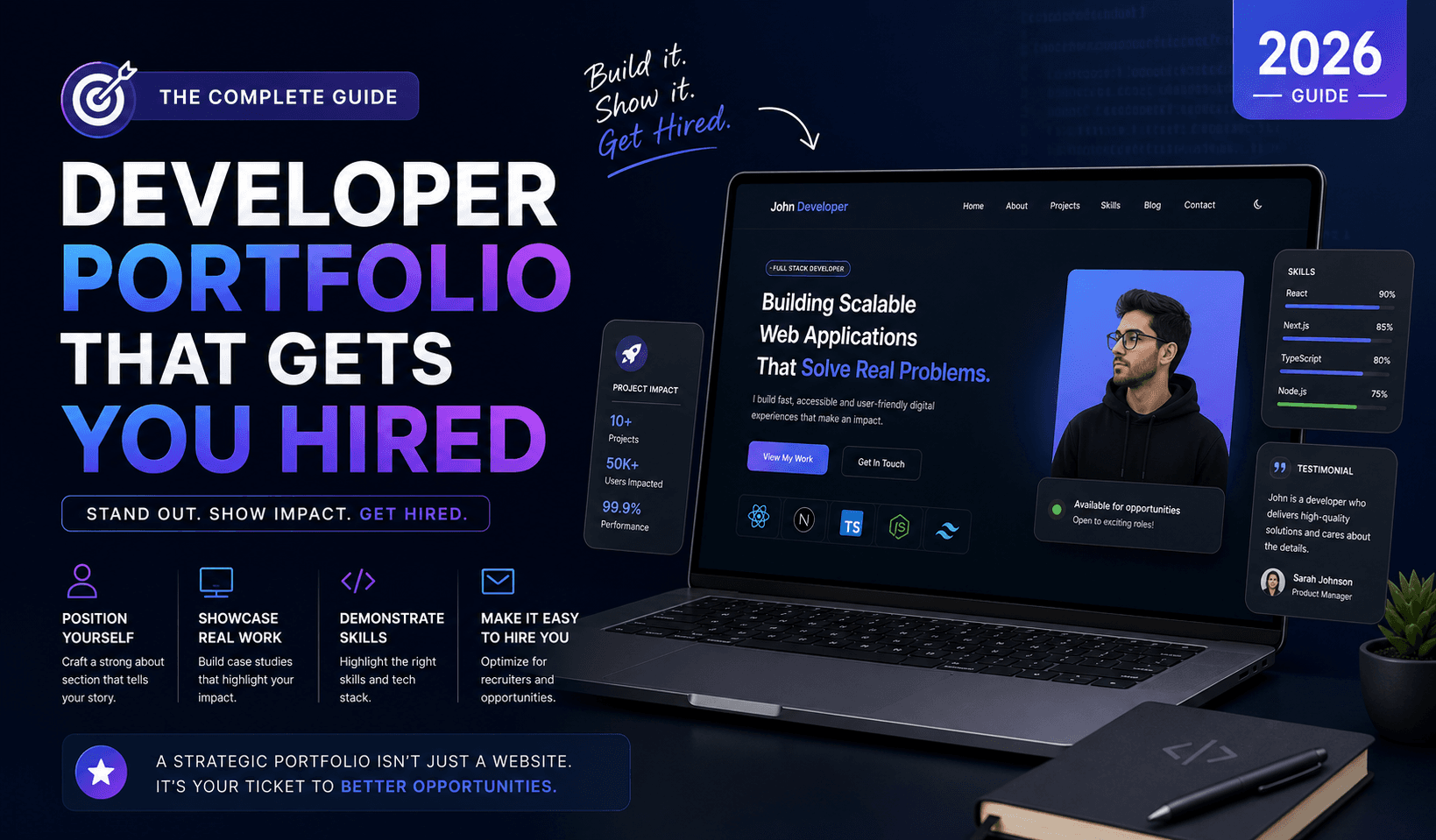
Most developer portfolios fail the same way: they're a list of projects, a tech-stack badge wall, and a "Hi, I'm…" paragraph. None of that answers the only question a hiring manager has — can this person ship and explain their work?
This is the playbook I've used to rebuild my own portfolio and review portfolios for friends going into interviews in 2026.
What changed in 2026
The bar moved. Anyone can scaffold a Next.js site in a weekend with an AI agent. A portfolio is no longer proof you can build a website — recruiters assume that. It's now a writing sample, a taste filter, and a credibility signal.
"Authentic blog posts from genuine practitioners are increasingly outranking generic corporate content." — TheeDigital, SEO Trends 2026
The same principle applies to portfolios. Generic = invisible.
The five sections that matter
┌──────────────────────────────────────────────────────┐
│  1. Hero       → one sentence, no buzzwords          │
│  2. Selected   → 3 projects max, with case studies   │
│  3. Writing    → 3–10 posts, evergreen + recent      │
│  4. About      → personality, not a CV dump          │
│  5. Contact    → one click, one channel              │
└──────────────────────────────────────────────────────┘
1. Hero — earn the scroll
One line that says what you build and who for. "Frontend engineer building fast, accessible interfaces for fintech" beats "Full-stack developer passionate about clean code" every time. Specificity is the entire game.
2. Selected projects — three, with case studies
Three projects with a real write-up will out-perform fifteen with just a screenshot. Each case study should answer four questions:
- What was the problem?
- What did you decide and why?
- What surprised you?
- How did you measure success?
Skip the "I learned a lot" closer. Replace it with a number — load time, conversion lift, error rate, team velocity. Numbers are evidence.
3. Writing — short, frequent, honest
You don't need a 50-post archive. Five strong posts that show how you think will out-recruit fifty SEO-stuffed tutorials. Pick topics where you have real lived experience: incidents, migrations, bad calls, hard tradeoffs.
4. About — be a person
A two-paragraph "about" with a real photo, real interests, and one slightly weird detail (a hobby, a recent book, a strong take) makes you memorable. Memorable beats polished.
5. Contact — one path, no friction
A single email link. Skip the contact form unless you're getting spammed. Hiring managers will not fill out a captcha-protected form on their lunch break.
Technical details that quietly matter
- Lighthouse 100 / 100 / 100 / 100. Yes, all four. If you can't make a portfolio score perfectly, why would I trust you with a production app?
- Real OG images. When someone shares your post on Slack, the preview is your first impression. Generate per-post OG images (Next.js
opengraph-image.tsxdoes this in five lines). - Dark mode that respects system preference. Tiny detail; signals taste.
- A working RSS feed. Costs nothing, signals "I think long-term."
The honesty filter
Before you publish, ask: if a stranger read only my portfolio, would they understand what I'm good at and what I'm not? If everything reads as "I'm great at everything," recruiters will assume you're great at nothing in particular.