Claude Opus 4.7 and the Rise of Adaptive Thinking Models
Why merging 'reasoning' back into the main model is a bigger UX shift than the benchmark headlines suggest — and what it means for builders.
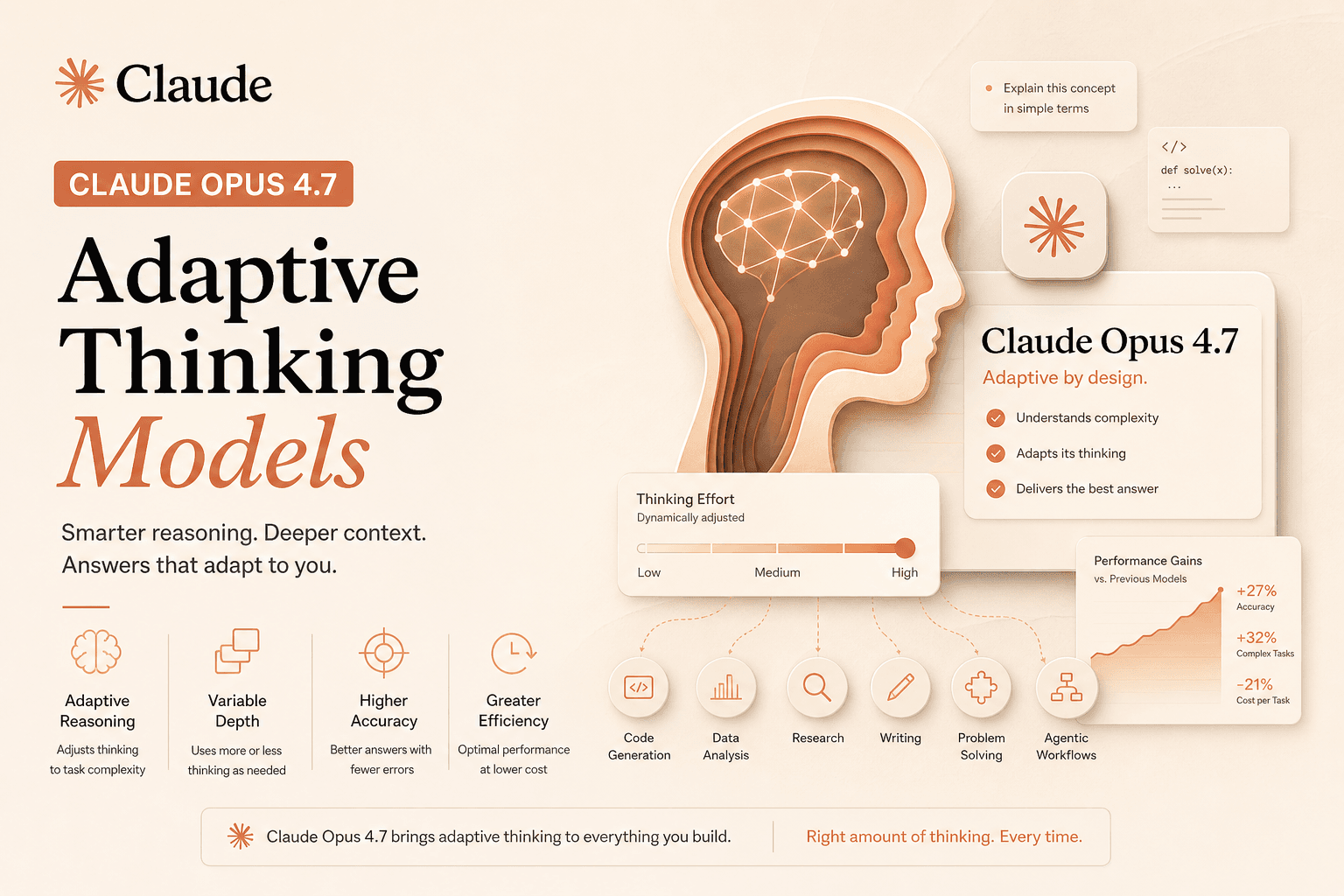
Anthropic released Claude Opus 4.7 in April 2026. The benchmark numbers got the headlines. The real story is buried in the architecture.
The death of the "thinking model"
Eighteen months ago, every frontier lab shipped two products: a fast model and a "reasoning" model. You picked one based on whether you wanted speed or depth. The choice felt important.
In 2026, that distinction quietly died.
"OpenAI's GPT-5.4 Thinking, Claude Opus 4.7 with adaptive thinking, and Gemini 3.1 Pro all blend reasoning into the main model rather than offering it as a distinct product." — llm-stats.com, May 2026
OpenAI retired o1 and o3. Anthropic merged its extended-thinking option into Opus. Gemini 3.1 dropped the "Pro Reasoning" SKU. There's just one model now — and it decides how hard to think.
What "adaptive thinking" actually means
              ┌──────────────────────────────┐
  Prompt  →   │  Adaptive routing layer      │
              │  - estimate difficulty       │
              │  - allocate compute budget   │
              │  - decide thinking depth     │
              └──────────────┬───────────────┘
                             │
            ┌────────────────┼────────────────┐
            ▼                ▼                ▼
       Quick reply     Medium thought    Deep reasoning
        (50 tok)         (1K tok)         (10K+ tok)
For a question like "what's the capital of France," the model spends almost no compute on internal reasoning and answers immediately. For "design a rate limiter for my API," it allocates a deep thinking budget before responding.
The user doesn't pick. The model does.
Why this matters for builders
If you're building on top of these APIs, three things changed:
1. The "which model do I call" decision got simpler.
You used to have to route between gpt-4o and o1, or between claude-sonnet and claude-opus-thinking. Now you call one model and trust it to allocate compute.
2. Latency got harder to predict.
A simple-looking prompt can sometimes trigger 15 seconds of deep thinking if the model decides the problem warrants it. Stream every response, and design your UI for variable latency.
3. Cost forecasting needs new instincts.
Token usage isn't a clean function of input length anymore. The same 200-token prompt can cost 10x more on Tuesday than Monday because the difficulty estimate shifted. Add per-call cost telemetry from day one — guessing won't work.
The product implications
The bigger story isn't the model — it's what the model enables.
"Anthropic has pushed Claude deeper into creative software, launched a security-focused product, and kept the industry talking about Claude Mythos, a model the company says can find software vulnerabilities at a level beyond many human experts." — blog.mean.ceo
Three things are happening simultaneously:
- Tool-use got reliable enough to ship. Claude Code, Cursor, and Windsurf all upgraded to Opus 4.7 in the same week. The "agent that opens a real PR" workflow is now table stakes.
- Context windows hit usable scale. The 1M-token context that arrived in Sonnet 4.6 is now standard in Opus 4.7. You can paste a whole repo.
- Memory is now default. Claude remembers preferences across conversations without explicit prompting.
What I'd watch next
Three open questions that will shape the rest of 2026:
- Will adaptive thinking close the gap with deliberate "thinking" prompts? When you explicitly say "think step by step," does that still help? Early evidence: less than it used to.
- Can the routing layer be gamed? A prompt-injection that convinces the model "this is easy" could quietly cap its depth. Security people are watching.
- What's the on-device version? Adaptive thinking on a phone changes the consumer-AI calculus completely.
The takeaway
If you're an API consumer, Opus 4.7 means: pick the latest, stream everything, instrument cost. Don't over-engineer model selection — the model is doing it for you now.
If you're a competitor lab, the message is harder: model differentiation is collapsing. The product moat is in the surrounding stack — memory, tools, IDE integration, eval — not the raw model.